Urszula Kubiczek, Centre for Communication and Marketing: Dr Zhang, please tell us a little more about yourself and your time here in Krakow.
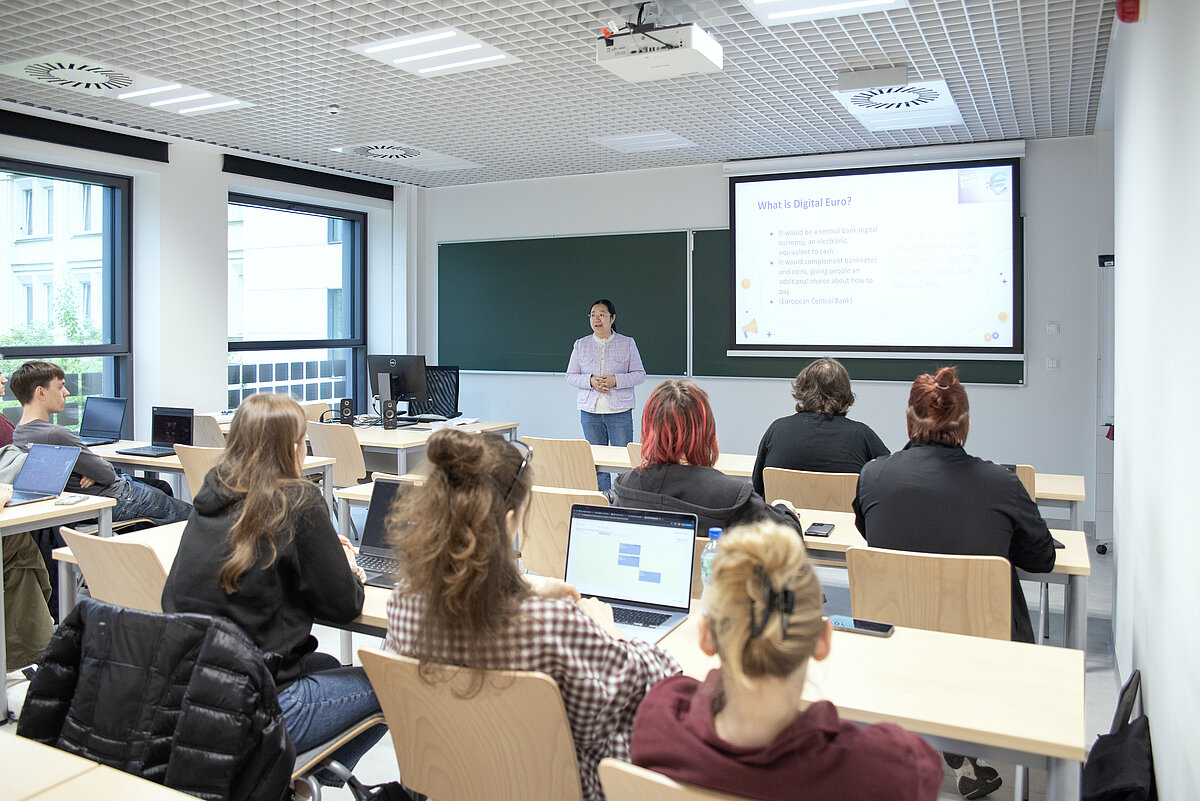
Dr Yuanyuan Zhang: Nǐ hǎo, hello! My name is Yuanyuan Zhang. I hold a PhD in Economics and I currently work at Guangdong Polytechnic Normal University in China. I came to AGH University as a visiting scholar to teach courses on digital currencies, focusing particularly on China’s digital yuan. My research interests lie in the transformation of industrial structures and the role of digital currency in economic development.
Before discussing blockchain, currency systems, and economic models, a warm-up question: what’s your favourite Polish word and why?
A word I learned from my students is chleb [EN: bread]. It might seem simple, but to me, this word represents much more than food. It symbolizes sharing, everyday life, and human connection. In Chinese, we say miànbāo (面包). When I first heard chleb and practiced the pronunciation with my students, it made me feel very welcome and connected to the culture. It is a regular word, but it left a big impression on me.
Academic bridges span continents and cultures. What brought you to AGH University, and how has your experience been so far?
I came here through an international teaching exchange programme between AGH University and Guangdong Polytechnic Normal University. I taught a course on digital currencies, and I found the students to be very open-minded, curious, and eager to share their perspectives. AGH University places great value on innovation and academic excellence, and the students here are willing to explore new ideas, which makes teaching very rewarding.
Great research often stems from personal experience and deep-rooted observation. What inspires you in your work?
I live in Guangzhou, a megacity in southeast China, where I have witnessed rapid economic growth and the profound impact of digital technologies on everyday life. These personal experiences and observations motivate me to study long-term economic growth and how digital technologies reshape not only China’s economy but also the fabric of our daily life.
In any fast-evolving field, there are challenges to navigate, but also exciting doors to open. What are the key challenges and opportunities in your research?
The biggest challenge is keeping up with the fast pace of change in digital currencies. However, this also creates great opportunities to uncover the underlying mechanisms by which digital technology influences both economic and social development. For example, digital currencies have the potential to improve financial inclusion, benefiting various groups of society. The field’s broad scope makes research in this area demanding and at the same time fulfilling.
Today’s research is global by nature. How important is international cooperation in your work?
International cooperation is essential to my work. I collaborate with researchers from Europe and Asia, deepening our academic understanding and fostering cultural exchange. These partnerships are crucial for studying the transformation of China’s industrial structure and its long-term economic development. Many scholars are eager to delve into this topic, as it reflects China’s evolving role in the global economy.
When a major economy like China transforms, it sends ripples across the globe. Dr Zhang, how is China’s industrial evolution impacting the world?
China has experienced a very rapid growth over the recent decades and is now shifting from an export-based model toward an innovation-driven economy. Digital technologies play a significant role in this transformation, affecting global supply chains and international partnerships. This evolution impacts not only China but economies worldwide. China has launched a digital currency, namely the digital yuan (e-CNY), which has been very well-received by the Chinese. In Poland and in the EU, discussions on the topic are very lively as well.
Every scholar has that one project or a breakthrough that defines their path. What are you most proud of?
I am very proud of my project analysing the heterogeneous impact of digital transformation on China’s service industry. The service sector is diverse, covering many subsectors with different characteristics. By studying these patterns of transformation, we can better understand how to identify new engines for sustainable economic growth in China.
Teaching is one thing, engaging students – mentoring the next generation of scholars – is something more. How do you involve your students in research?
I believe learning and research are deeply connected. I encourage my students to actively participate in my projects by collecting data, conducting case studies, and even co-authoring papers with me. The involvement helps them develop critical thinking skills and fosters a genuine curiosity for academic research. Also, I deliver classes on the topic of digital currencies, we share a lot of different ideas and opinions on the development of traditional currencies, digital currencies, and also the impact of digital currencies on the whole world.
For early-career researchers, advice from experienced academics can be a guiding light. What words of wisdom would you share with them?
Be curious and persistent. Choose a research topic that you truly love and commit to it. Doing meaningful research is often challenging and requires long-term dedication. Let your passion guide you, believe in yourself, and focus on what excites you. With time, your field of interest will yield insights of substantial depth and lasting value.
Will the future of economics belong to the innovators, the thinkers, the analysts, or all of them? What future do you see in your field, and would you recommend AGH University to students from China?
The future of economics belongs to all these groups – innovators, thinkers, and analysts alike. My field, focusing on China’s economic transformation, is truly dynamic. I strongly encourage Chinese students to study abroad, and the AGH University of Krakow is an excellent choice. Here, I have met many bright, creative, and open-minded students, and the university fosters an environment that values diversity, innovation, and curiosity.
And now, a message straight from the heart – in your native language.
Huānyíng Zhōngguó xuéshēng lái Kèlākēfū de AGH kējì dàxué xuéxí! (中文: 欢迎中国学生来克拉科夫的AGH科技大学学习
[EN: I warmly invite Chinese students to study at AGH.]
And finally, how do you say “Thank you very much” in Chinese?
Fēicháng gǎnxiè (中文: 非常感谢).
View more episodes