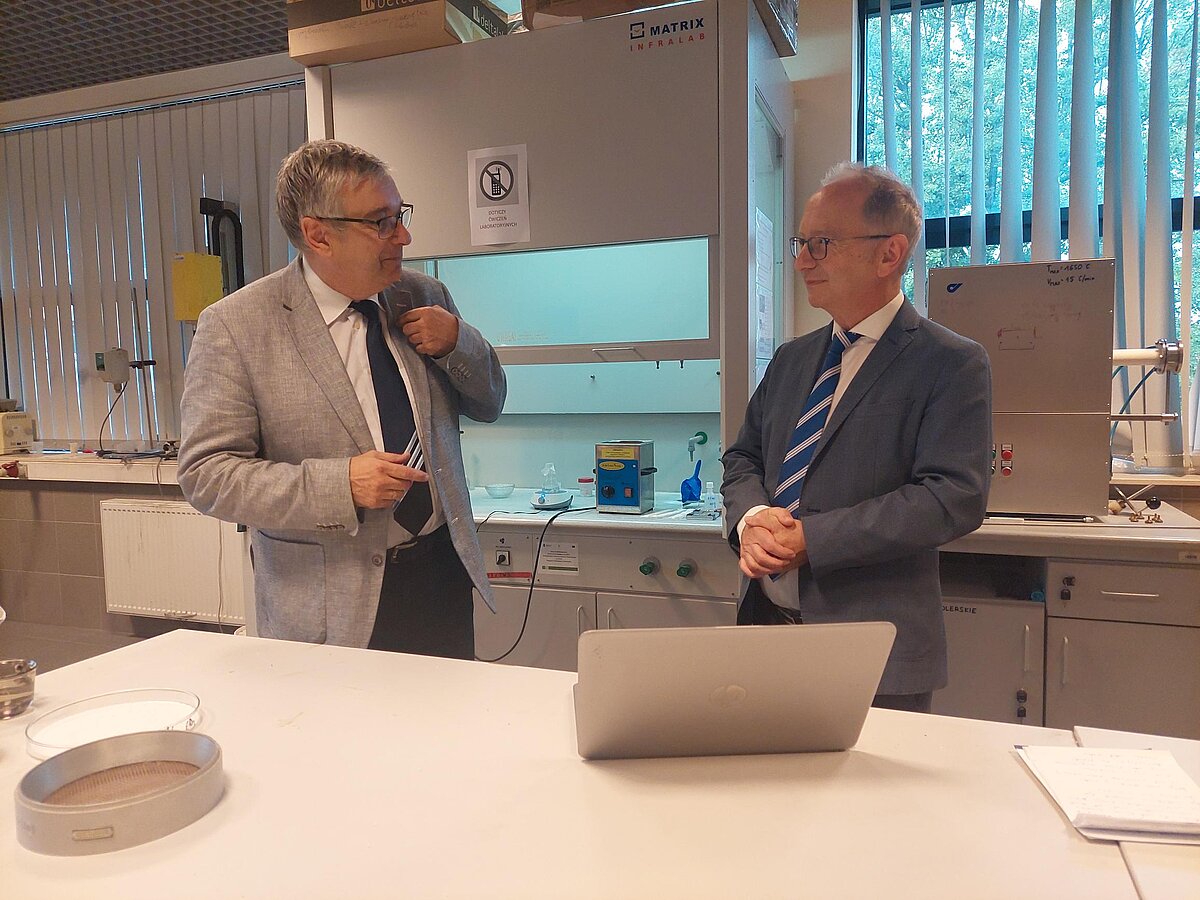
Urszula Kubiczek (Centre for Communication and Marketing): Professor Graule, it is a great pleasure to have you with us as part of the AGH University International Faces series. You have worked across Europe, led research at one of Switzerland’s top scientific institutions, and have been working with AGH University for many years. Let us begin right here in Krakow: what first brought you to our university?
Professor Thomas Graule: Thank you very much. My connection with AGH University dates back to 2001, when a young scientist from AGH University came to Empa for a research internship. That visit sparked a collaboration that has grown ever since, through student exchanges, joint PhDs, and many successful research projects. Over time, AGH University has become one of our strongest and most trusted partners.
You are a chemist by education, yet your work focusses on advanced ceramics. What inspired you to explore this field?
My passion began during my PhD at a Max Planck Institute. I was fascinated by the chemistry behind ceramic materials and how powders and surfaces can be modified to create new properties. Ceramics combines chemistry, physics, and engineering. The materials are simple in form but extremely complex in function. That complexity still fascinates me today. As a chemist, I became deeply interested in the chemistry behind ceramic materials: in powders, surfaces, and their modification. That’s how my passion for ceramics began.
Your research spans many topics, from nanopowders to clean energy materials. What are you most excited about nowadays?
I am especially interested in ceramics for sustainable energy, solid-state batteries, heat storage systems, and membranes for gas separation. These materials are essential for the energy transition. The challenge now is how to make them scalable and affordable. Additive manufacturing and new synthesis methods are key.
You have led international teams at Empa, working with scientists from all over the world. What do you think makes international collaboration so valuable?
Diversity drives innovation. At Empa, our lab included researchers of up to 20 nationalities – it resembled a small United Nations but for science. Working with young academics from different backgrounds brings new ideas, poses new questions and new ways of thinking, and at the end it is endlessly rewarding. And it is not just about science – it is about growing together as human beings.
You have also been teaching AGH University summer schools for over a decade. What makes this experience meaningful to you?
The collaboration between AGH University and Empa began 20 years ago, when a young student from Krakow joined our team. This single exchange became the seed of a long and fruitful partnership. Since then, more than a dozen PhD and master’s students have participated in joint programmes, produced high-quality publications, and built long-lasting friendships. AGH University is our strongest partner. What started as a student visit has grown into a network of collaboration across multiple faculties. Every summer I come back, I feel their energy and curiosity. Teaching is a two-way process – I always learn something new from them as well. It’s wonderful to see how quickly young researchers grow when given the opportunity to participate in international projects. Teaching in Krakow has given me as much inspiration as I hope I have given them.
In your view, what are the biggest challenges materials science has to face today?
Ceramics play a crucial role in clean energy. Solid-state batteries, heat storage systems, gas separation membranes, they all rely on advanced ceramics. These materials will be the key to building a sustainable energy future. However, they can be costly to produce. That’s why we must look to new technologies, such as additive manufacturing, to make them more accessible.
And what do you think the future holds? What might surprise us in 10 or 20 years?
I believe ceramics will be central to energy technologies, from solid-state batteries to renewable energy storage. We will also see materials that are self-healing, adaptive, and fully recyclable.
Many of our students dream of building international research careers. What advice would you give them?
To young researchers, I always say, “seek international experiences. Be open-minded: travel, collaborate, attend conferences, exchange ideas – they open your mind and help you see your work in a global context. Science grows when we share knowledge and remember that curiosity is your best guide.”
Professor Graule, what message would you like to share – in your native German – with students from abroad who might be considering studying or conducting research at AGH University?
Ich möchte alle Studierenden aus dem Ausland herzlich einladen, an die AGH-Universität Krakau zu kommen. Hier findet man nicht nur exzellente Forschung und hochmotivierte Wissenschaftlerinnen und Wissenschaftler, sondern auch eine offene, freundliche Atmosphäre und eine wunderschöne Stadt voller Geschichte und Kultur. Krakau ist ein Ort, an dem man sich akademisch weiterentwickeln und zugleich menschlich wachsen kann.
[ENG: I would like to warmly invite all international students to come to the AGH University of Krakow. Here you will find not only excellent research and highly motivated scientists, but also an open, friendly atmosphere and a beautiful city full of history and culture. Krakow is a place where you can grow both academically and personally.]
Finally, for many years, you have worked closely with Rector Jerzy Lis. How would you describe that collaboration?
It’s a friendship built on trust and shared passion. We have worked together for two decades, not only in ceramics, but across many fields. Science grows when people connect, and I am grateful for that partnership.
Professor Graule directly addresses Rector Jerzy Lis: “Jurek, let us continue our cooperation across all faculties. Together, we have built something that goes beyond science.”
Rector’s response: “Thomas, our friendship shows that true international science grows from personal ties. Your passion, precision, and kindness have shaped generations of students. Our cooperation is a living example of how friendship becomes the foundation of science.”
View more episodes