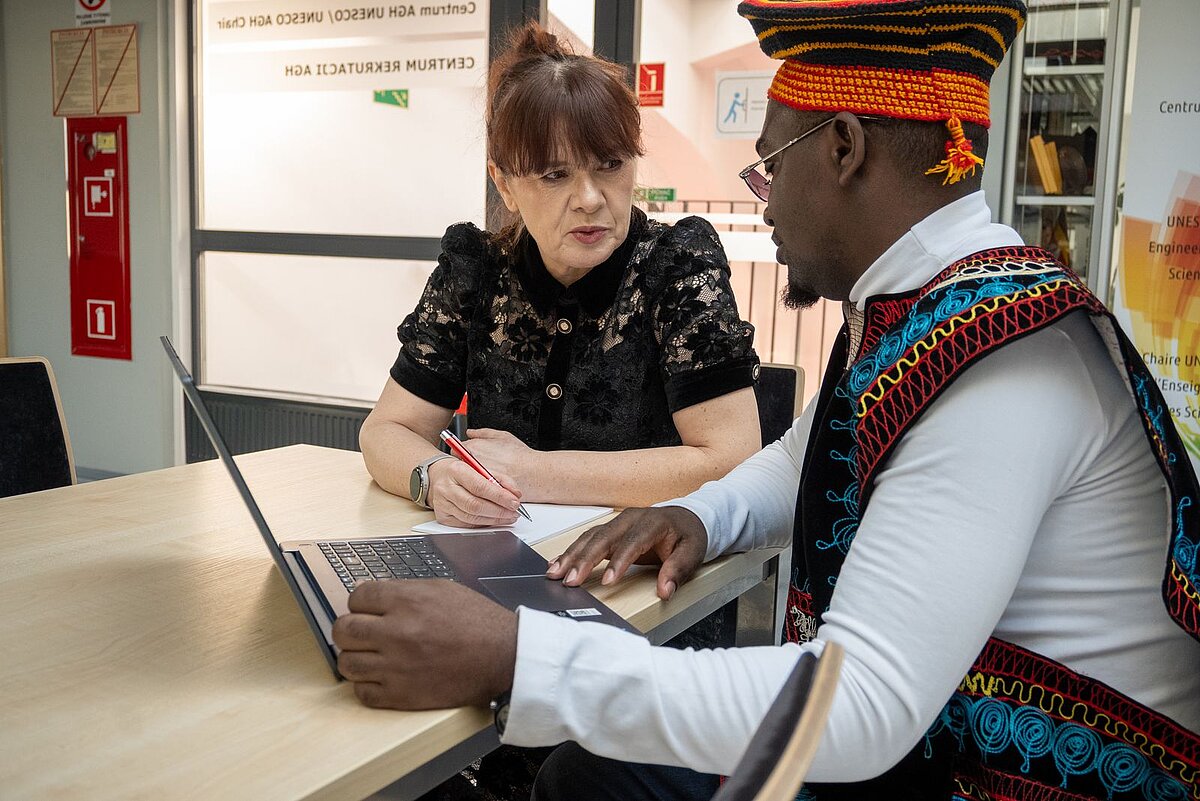
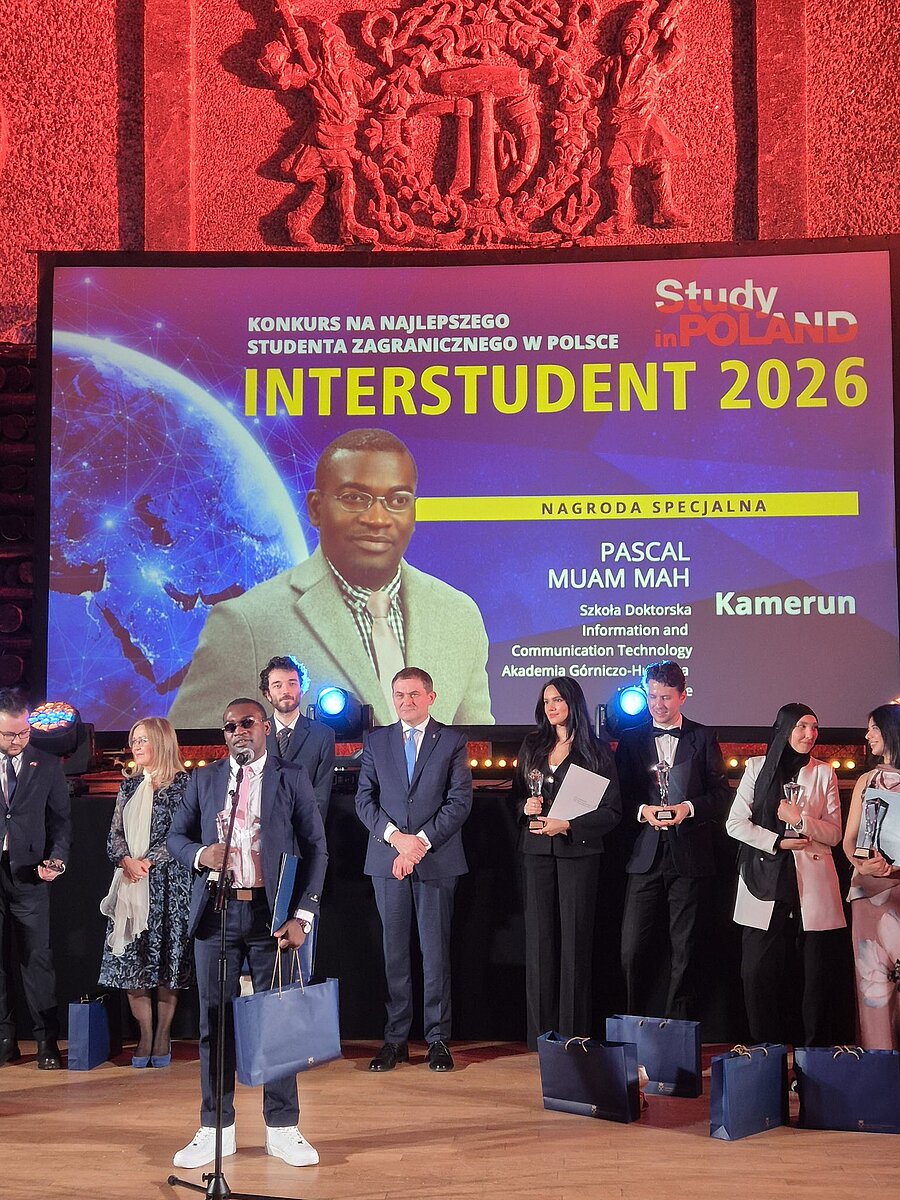
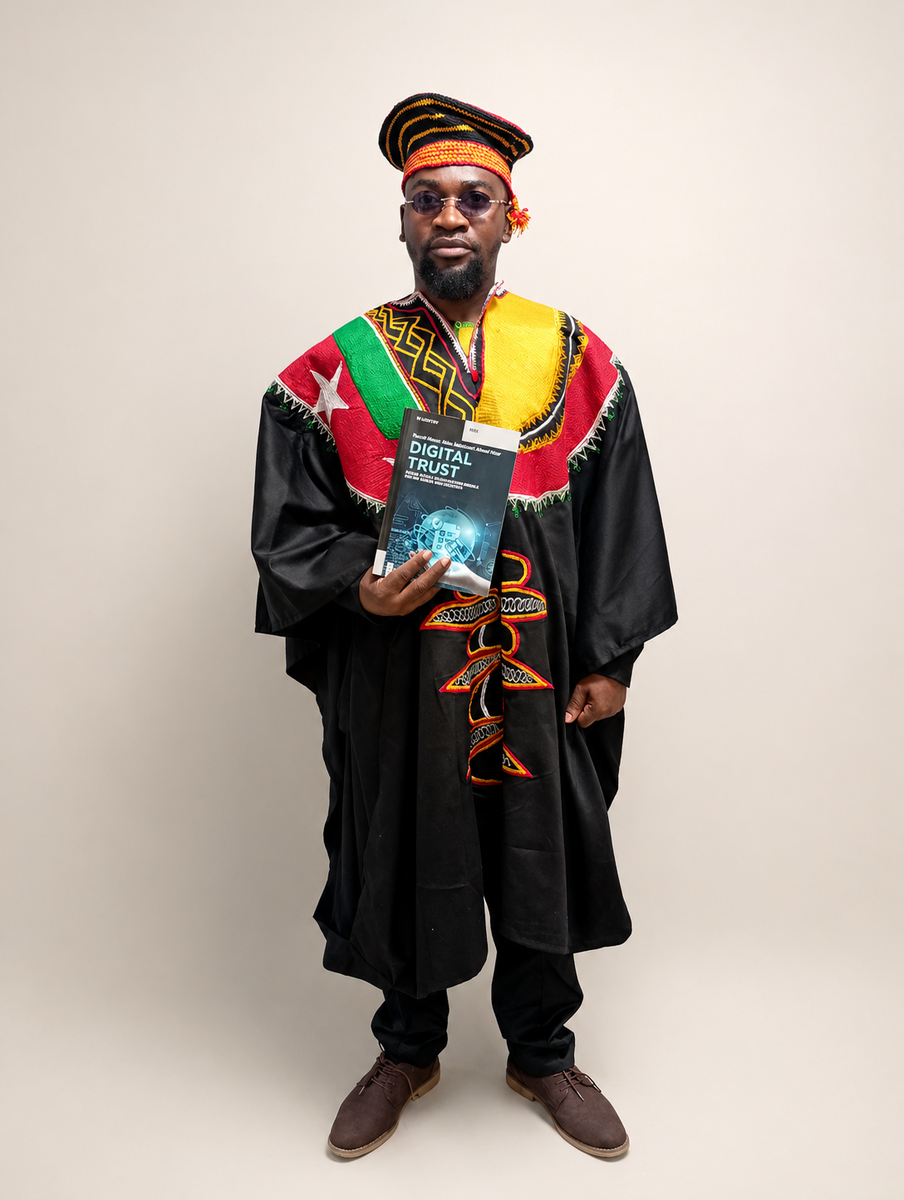
Urszula Kubiczek, Centre for Communication and Marketing: Pascal, welcome to AGH University International Faces. Could you introduce yourself and tell us where your journey began?
Pascal Muam Mah: My name is Pascal Muam Mah. I come from Cameroon, from a small village called Mentang in the Northwest Region.
In Cameroon, names are deeply connected to identity, family, and tradition. Due to Christianity, many people have official names used for baptism, but we also have traditional names that carry cultural meaning and history. Some come from my mother’s side, others from my father’s side. Even if they do not always appear on official documents, these names are part of who I am.
Could you tell us more about your country and what shaped you?
Cameroon is often called “Africa in miniature” because you can experience almost the entire continent within one country. We have deserts, rainforests, mountains, beaches, and extraordinary cultural diversity. We live among many ethnic groups, languages, and traditions. Growing up in that kind of environment teaches you from an early age to understand differences and embrace diversity. I believe this has shaped the way I view both people and technology today.
What led you to choose Poland and AGH University for your academic journey?
I would say my decision was driven by my passion for research. Since childhood, I have dreamed of becoming a researcher or academic writer. When I was in primary school, I used to imagine that one day students would study from books written by me. That vision has stayed with me. I even wrote a small collection of around one hundred poems. When I tried to publish it in Cameroon, it became clear how difficult it was to develop academically in the environment I was living in at the time. That was the moment I realised I needed to go abroad if I wanted to grow. That was when I started searching for universities beyond Cameroon.
Poland became one of the most realistic and accessible opportunities for me. I was also interested in the culture and educational system. When I discovered AGH University, I saw a place where science, innovation, and technology could connect with real-world impact.
Today, when I look back, I can say that coming here completely transformed my academic journey. Before my arrival, I had no scientific publications. Now I have authored more than 40 papers, published a book, and completed two doctoral thesis paths, including one based on scientific publications.
What did you expect before coming to Poland, and how different was the reality?
At the beginning, I was honestly a bit afraid. I imagined that life in a developed country would be extremely expensive and academically overwhelming. I worried about whether I would be able to adapt or keep up with the educational level. But when I arrived in Krakow, the experience was very different from what I expected. I found supportive lecturers, welcoming Polish friends, and an academic environment that encouraged growth. Even in difficult moments, there were people who helped me. That support changed everything for me.
What surprised you most about studying and living in Poland?
The sheer number of opportunities available to students: scholarships, funding programmes, research support, and academic mentoring. It was something that took me by surprise. It showed me that academia has the power to transform lives when there is real investment in students and research.
In simple terms, what is your research about and how is it relevant today?
My research combines artificial intelligence, natural language processing, data science, and digital trust technologies. The goal is to help people and organisations better understand information, make faster and more reliable decisions, and build trust within digital ecosystems. I am particularly interested in how intelligent systems can become more secure, transparent, and socially responsible.
My work also explores how AI can support education, healthcare, digital services, and research management. Beyond research itself, I try to connect science and technology in ways that create practical and socially meaningful solutions.
Could you tell us more about your book Digital Trust and your research idea?
Today, we live in a world built around digital interaction, but many of these interactions are anonymous. That creates serious challenges connected to security, misinformation, identity, and accountability. Digital trust is about building systems where users can be identified securely and responsibly while still protecting privacy and accessibility. This becomes especially important in areas such as healthcare, education, finance, and public digital services. One of the ideas behind my book was the conviction that online systems should not only be intelligent, but also trustworthy. We began exploring how digital identity systems could help reduce misuse, fraud, and anonymous abuse across platforms.
As part of this work, we developed the Open-Source Digital Trust Identification System, an open-source platform focused on secure and verifiable digital identity. The long-term vision is to create digital ecosystems where people remain accountable for their actions while still benefiting from openness and global connectivity.
What are the biggest challenges when working with AI and natural language processing (NLP)?
Language diversity is the most demanding issue. AI systems need data and linguistic understanding in order to work effectively. The problem is that most models are trained mainly on dominant languages such as English. But language is never uniform. American English, British English, and the English spoken across many African countries all differ in vocabulary, context, and cultural expression. In Cameroon alone, there are hundreds of languages and dialects.
For AI systems, understanding this diversity is extremely difficult. The challenge is not only technical – it is also cultural. If intelligent systems are trained exclusively on dominant languages and perspectives, entire communities can become digitally excluded. That is why I believe future AI systems must become more culturally aware and inclusive. Technology should adapt to people, not the other way around.
How do you see AI contributing to development in Cameroon?
I believe technology can make a difference in Cameroon, as we are still catching up in many areas of digital development. Today, some companies are already training AI models using African languages, but only a small number of languages are represented. If we build our own systems, we can integrate cultural and linguistic diversity and make technology more accessible.
The future depends on creating technologies that include different cultures rather than excluding them. Also, we can create solutions that are not too costly. For me, sustainable technological development is not only about innovation. It is also about inclusion and equal access to knowledge.
What advice would you give to students who want to study at AGH University?
My advice is simple: don't be afraid of your ideas. Sometimes a seemingly insignificant idea can become something that changes the world. Stay focused, stay consistent, and never give up when challenges arise along the way. A professor at AGH University once told me, “Never be afraid of your idea.” That sentence stayed with me throughout my academic journey.
I believe that every student has the potential to create something meaningful, but first, they need the courage to believe in their own vision. Studying at AGH University taught me that growth comes not only from knowledge, but also from persistence, curiosity, and the willingness to step beyond your comfort zone.
Thank you so much, Pascal!
Thank you very much. It was a real pleasure to share my journey and be part of AGH University International Faces. I hope my story encourages other students to believe in their ideas and follow their ambitions.
***
Behind every researcher is a human story shaped by culture, ambition, and perseverance. From a small village in Cameroon to advanced research in artificial intelligence at the AGH University of Krakow, Pascal Muam Mah demonstrates how curiosity, determination, and education can transform both individual lives and communities.
His work in artificial intelligence, digital trust, and language technologies focuses on an important challenge of today’s world: creating digital systems that are not only smart, but also safe, reliable, and accessible for people from different cultures and backgrounds.
***
Special thanks to Professor Iwona Skalna (Faculty of Management, AGH University) and Dr Tomasz Pełech-Pilichowski (Faculty of Computer Science, AGH University) for their support and contribution to this episode.
View more episodes